

The Hollywood acting industry emerged from its historic 2023 dual strikes with new AI protections and wage increases, but faces ongoing challenges from streaming economics and an all-time low in pilot production. SAG-AFTRA’s 160,000+ members secured precedent-setting contracts that prioritize human creativity over automation, while industry data reveals stark realities about career sustainability and income inequality that persist despite union victories.
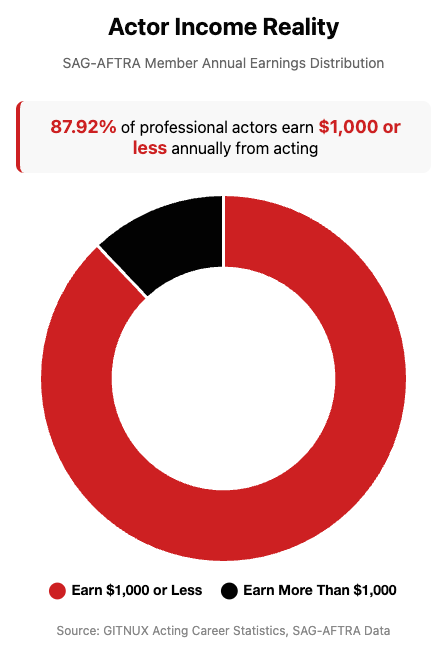
The 2023 strikes, lasting 148 days and costing the industry $1.5 billion, fundamentally reshaped how actors navigate an increasingly digital landscape. With only 12.08% of SAG-AFTRA members earning more than $1,000 annually and unemployment rates reaching 90%, the industry’s economic structure remains challenging despite technological protections. Meanwhile, streaming platforms continue reshaping traditional career pathways, with pilot season hitting historic lows as networks favor straight-to-series orders over traditional development models.
Hollywood Acting Industry Statistics 2025 (Top Picks)
- 160,000-170,000 SAG-AFTRA members represent professional actors, with historic high of 171,157 in 2022
- 90% of actors are unemployed at any given time, highlighting industry’s competitive nature
- $6,622-$21,538+ weekly minimums for major television roles under 2025 SAG contracts
- 47.6% of leading roles went to women in 2024, up dramatically from 32.1% in 2023
- 29.2% of lead actors are people of color, representing an 8% increase from previous year
- 4-5 pilots per network in 2023-24 season, marking all-time lows in traditional development
- $2.83 trillion global entertainment market with 5% growth despite industry disruptions
Who Are The Working Actors in Hollywood?
SAG-AFTRA represents approximately 160,000 to 170,000 professional actors, performers, and media professionals as of 2025, marking one of the largest entertainment unions globally. However, membership statistics reveal concerning employment realities: about 33% of total membership is classified as “withdrawn,” “suspended,” or otherwise inactive, with “honorable withdrawals” comprising 20% of total membership at 46,934 members.

The union reached a historic membership high of 171,157 regular members in April 2022, contributing nearly $1 billion in membership dues and agency fees. Despite this substantial membership base, recent data from Nature Communications analyzing 1.5 million actors reveals that approximately 90% of actors are unemployed at any given time, with most careers spanning only a single year and following a “rich-get-richer” pattern where established actors secure increasingly more opportunities.
The Bureau of Labor Statistics estimates 135,600 total actors in the United States when accounting for both employed and unemployed performers, with 8,600 projected annual job openings and 5% employment growth projected from 2023-2033. These numbers reflect both the industry’s expansion and its intensely competitive nature.
Hollywood Actors Broken Down By Gender
Gender representation in Hollywood shows mixed progress with significant recent gains in on-screen roles but persistent disparities behind the camera. Women secured 47.6% of leading acting roles in 2024, representing a dramatic increase from 32.1% in 2023, according to UCLA’s Hollywood Diversity Report. This jump suggests industry-wide efforts to address historical gender imbalances may be gaining momentum.
Among working entertainment professionals, 54.3% identify as female while 45.7% identify as male, with an average age of 42 years across all performers. However, research indicates gender bias significantly affects career longevity, with female actors showing shorter career spans than male counterparts in longitudinal studies tracking industry performance over time.
Behind the camera, progress remains slower. Women composed only 15% of directors in theatrical releases, while female writers saw representation decline to 22.1% of credited writers in 2024, down nearly 5 percentage points from their 2022 high. The contrast between on-screen gains and behind-the-scenes challenges highlights ongoing systemic barriers despite increased awareness.

Hollywood Actors Broken Down By Age
The acting profession skews toward experienced performers, with the average working actor age at 42 years old according to industry demographics data. This reflects both the time required to establish sustainable careers and the industry’s preference for proven talent in key roles.
Career pattern analysis reveals that most actors’ peak productive years occur early in their careers, with researchers able to predict with 85% accuracy whether an actor’s best year has passed. The data suggests that sustained activity and consistent work prove more predictive of long-term success than individual high-profile roles, emphasizing the importance of building steady professional momentum.
Age demographics become particularly significant given that most acting careers span only a single year, according to comprehensive IMDb data analysis. This statistic underscores both the industry’s competitive nature and the challenge of transitioning from occasional work to sustainable career development across age groups.
Hollywood Actors Broken Down By Geography
The entertainment industry maintains significant geographic concentration, with Los Angeles continuing to serve as the primary hub for film and television production. While specific 2025 data on geographic distribution remains limited, SAG-AFTRA maintains national offices in Los Angeles and New York with local offices nationwide, reflecting membership concentration in major media markets.
Industry production data shows filming location trends that directly impact where working actors can find opportunities. The 2023 strikes reduced filming days significantly in Los Angeles, with production levels not expected to return to pre-strike levels until potentially 2025, affecting geographic employment patterns.
International co-production trends are increasingly affecting Hollywood actor opportunities, with streaming platforms driving demand for content that appeals to global audiences. This shift creates new opportunities for actors who can work in multiple markets while potentially concentrating certain types of production in specific geographic regions.
How Popular Is Acting as a Career?
In The World
Acting enjoys global popularity as a career aspiration despite challenging employment realities. The global entertainment and media market reached $2.83 trillion in 2023 with 5% growth, indicating continued expansion that theoretically creates more opportunities worldwide. However, this growth doesn’t translate directly to increased employment security for individual performers.
International entertainment markets show varying growth patterns, with streaming platforms driving much of the global expansion. The rise of regional content production for platforms like Netflix, Amazon Prime, and local streaming services creates opportunities for actors to work in multiple markets, though competition remains intense globally.
Professional training programs worldwide report strong interest, with conservatory and university acting programs maintaining robust application numbers. However, the disconnect between training capacity and sustainable career opportunities remains a global challenge, not unique to Hollywood.
In The US
Acting’s popularity in the United States reflects both cultural fascination with entertainment careers and practical challenges of industry employment. 31.9% of working actors hold bachelor’s degrees or higher, suggesting many pursue substantial education before or alongside their acting careers.
The U.S. Bureau of Labor Statistics projects 5% employment growth for actors from 2023-2033, which is about average compared to other occupations. However, this growth prediction must be contextualized against the reality that only 12.08% of SAG-AFTRA actors earned more than $1,000 in a single year, highlighting the gap between available roles and sustainable income.
Educational investment in acting training remains substantial, with college programs averaging $9,600 annually for public institutions and $33,000 for private colleges. Training program success varies significantly, with specialized conservatory programs showing higher industry placement rates but also requiring intensive time commitments of 22-45 hours weekly compared to 14-18 hours in traditional college programs.
Why Do People Pursue Acting Careers?
Despite challenging employment statistics, actors continue entering the profession driven by artistic passion, storytelling opportunities, and the potential for significant creative and financial rewards. The industry’s “rich-get-richer” dynamics mean that successful actors can achieve substantial earnings, with top performers earning well above the $202,000+ highest salary bracket.
Industry surveys and career studies indicate that actors are motivated by the opportunity to participate in cultural storytelling and creative expression. The 2023 strikes demonstrated strong union solidarity and commitment to artistic integrity, particularly around AI protections that preserve human creativity in storytelling processes.
Career flexibility and project variety also attract performers who value diverse work experiences over traditional employment stability. Many actors combine performance work with related creative careers in writing, directing, or production, leveraging their industry knowledge across multiple revenue streams.
What Are The Most Popular Acting Training Methods?
Conservatory vs. College Training
Conservatory training focuses 75% or more of coursework on performance skills, requiring 22-45 hours of weekly supervised practice compared to 14-18 hours in college programs. These intensive programs provide direct industry connections with agents, directors, and entertainment lawyers, often resulting in higher immediate placement rates in professional work.
(Interested in Acting Classes? Contact Bernard Hiller to learn more).
College programs offer broader liberal arts education with performance training, typically requiring 30-50% of credits in theater/film for BA degrees and 70-80% for BFA programs. While less intensive in pure performance training, college programs provide networking opportunities and credential flexibility that can support longer-term career development.
Training cost analysis shows significant variation, with public colleges averaging $9,600 annually for in-state students and private institutions at $33,000 annually. Conservatory costs vary widely but often require certificate rather than degree completion, potentially reducing overall investment time.
Success Rate Data
Made in NY Production Assistant Training Program demonstrates measurable training effectiveness, with 80% of graduates finding full-time employment within three months across its 16-year operation. The program trained over 1,100 participants with approximately 80 annual participants, providing both 5 weeks of training and 2 years of ongoing support.
Carnegie Mellon Entertainment Industry Management reports 90% of graduates finding full-time employment within six months, though with smaller cohorts of approximately 30 students annually. These specialized programs show significantly higher success rates than general population statistics.
Training background analysis reveals that educational attainment among working actors shows 31.9% holding bachelor’s degrees or higher, suggesting that formal education provides some career advantages even if not directly correlated with immediate employment success.
How Much Is The Acting Industry Worth?
Industry Valuation Growth
The global entertainment and media industry reached $2.83 trillion in 2023, representing 5% growth despite economic headwinds and industry disruptions from strikes and streaming transitions. PwC projects the market will reach $3.4 trillion by 2028, growing at a 3.9% compound annual growth rate.
Advertising revenue is projected to hit $1 trillion in 2026 and account for more than half (55%) of total entertainment industry revenue growth over the next five years. This shift toward advertising-supported models reflects streaming platforms’ search for sustainable revenue as subscription growth slows.
The movies and entertainment market specifically grew from $99.4 billion in 2023 to an expected $202.9 billion by 2033, with a 7.4% compound annual growth rate. North America maintains market leadership with 34.7% of global market share and approximately $34.4 billion in revenues for 2023.
Revenue Growth in Entertainment
Streaming/OTT video is projected to reach $94 billion by 2025, up 60% from current levels, including more than $81 billion in subscription revenue and nearly $13 billion in transactional video on demand. However, streaming platforms face increased competition and profitability challenges, leading to industry consolidation and exploration of ad-supported models.
Corporate entertainment market growth shows expansion from $4.34 billion in 2023 to $5 billion in 2024, with projections reaching $12.34 billion by 2030 at a 16.10% compound annual growth rate. This segment reflects increased corporate investment in employee entertainment and experience-based marketing.
Technology integration drives much industry growth, with virtual reality projected to grow 24% annually and data consumption expanding 26% yearly through 2026. These technological shifts create new opportunities for actors while also raising questions about traditional performance roles.
Acting Career Success and Training Statistics
Career longevity data reveals challenging realities despite industry growth. Most acting careers span only a single year, with the most productive year typically occurring early in an actor’s career. Researchers can predict with 85% accuracy whether an actor’s best year has passed, indicating predictable career trajectory patterns.
Income distribution among SAG-AFTRA members shows extreme inequality: only 12.08% earned more than $1,000 in a year, while the median hourly wage sits at $23.33 according to Bureau of Labor Statistics data. Annual salary ranges span from under $29,120 for the lowest 10% to over $202,000 for the highest 10% of earners.
Training effectiveness varies significantly by program type and individual circumstances. Conservatory graduates show higher immediate industry placement due to intensive training and direct industry connections, while college program graduates benefit from broader education and networking opportunities that support longer-term career development.
Future Outlook for the Hollywood Acting Industry
The industry faces a fundamental transition period following the 2023 strikes and ongoing streaming evolution. New AI protections secured in SAG-AFTRA contracts establish precedent-setting guidelines that prioritize human creativity while allowing technology as a collaborative tool rather than replacement.
Pilot season transformation represents a significant structural change, with traditional pilot orders at all-time lows of 4-5 per network in 2023-24. Networks increasingly favor straight-to-series orders over traditional development models, potentially changing how actors build careers and gain industry visibility.
Streaming platforms’ search for profitability will likely reshape content production and actor opportunities. While the $94 billion projected streaming revenue by 2025 indicates continued growth, platforms are consolidating operations and reducing original content spending after years of aggressive expansion.
International market expansion creates new opportunities for actors willing to work globally, with streaming platforms driving demand for content that appeals to diverse international audiences. This trend may favor actors with multilingual abilities and cultural flexibility.
Wrapping It Up
Hollywood’s acting industry in 2025 reflects both significant progress and persistent challenges. The historic 2023 strikes secured crucial AI protections and wage increases, establishing important precedents for human creativity in an increasingly digital landscape. SAG-AFTRA’s 160,000+ members now have stronger contractual protections, though underlying employment realities remain challenging with 90% unemployment rates and extreme income inequality.
Demographic progress shows meaningful gains, with women achieving 47.6% of leading roles in 2024 and people of color representing 29.2% of lead actors. However, behind-the-camera diversity lags significantly, and career sustainability remains elusive for most performers regardless of demographic background.
The industry’s $2.83 trillion global valuation indicates continued economic vitality, but structural changes in pilot production, streaming economics, and technology integration require actors to adapt their career strategies. Training investment remains crucial, with specialized programs showing higher success rates, though no training method guarantees sustainable career outcomes in this highly competitive field.
Future success will likely depend on adaptability to technological change, global market opportunities, and diversified skill development that extends beyond traditional performance roles into writing, producing, and digital content creation.
Frequently Asked Questions
How many professional actors work in Hollywood? SAG-AFTRA represents approximately 160,000-170,000 professional actors and media professionals, though about 90% are unemployed at any given time. The Bureau of Labor Statistics estimates 135,600 total actors nationwide.
What do actors actually earn in Hollywood? Only 12.08% of SAG-AFTRA actors earned more than $1,000 in a year. The median hourly wage is $23.33, with annual salaries ranging from under $29,120 to over $202,000. Current SAG minimums range from $1,204 per day for guest stars to $21,538+ per episode for series regulars.
How successful are different acting training programs? Specialized training shows higher success rates: Made in NY programs place 80% of graduates in full-time work within three months, while Carnegie Mellon places 90% within six months. However, most actors (90%) remain unemployed regardless of training background.
What changed after the 2023 Hollywood strikes? The 148-day strikes secured AI protections ensuring actors control how technology is used in their work, plus wage increases of 5% in 2023, 4% in 2024, and 3.5% in 2025. The strikes cost the industry approximately $1.5 billion but established precedent-setting technology protections.
How has streaming affected actor opportunities? Streaming created new opportunities but also challenges. Pilot season hit all-time lows with only 4-5 pilots per network, as platforms favor straight-to-series orders. While streaming revenue is projected to reach $94 billion by 2025, platforms are reducing original content spending for profitability.

Acting can seem like a mysterious world filled with glamour and talent, but it’s also a craft that requires dedication and knowledge. Aspiring actors often have a myriad of questions about the industry, techniques, and how to break into the competitive landscape. Understanding the basics can make all the difference in navigating this exciting journey.
From audition tips to understanding different acting methods, answering common FAQs can empower actors at any stage of their careers. Whether someone is just starting out or looking to refine their skills, having clear answers can help demystify the process and build confidence. This article tackles the most frequently asked questions about acting, providing insights that can guide anyone toward success in this vibrant field.
What Is Acting?
Acting involves portraying a character in various performance media, including film, theater, and television. It requires emotional expression, memorization of lines, and the ability to convey thought processes and motivations convincingly. Actors breathe life into fictional characters and represent diverse human experiences, making effective communication, observation, and creativity essential skills for success in this craft.
What Are the Different Types of Acting?
- Theatrical Acting: Performed live on stage, focusing on strong vocal delivery and stage presence.
- Film Acting: Involves subtlety and camera awareness, requiring actors to adjust their performance for different shot types and angles.
- Television Acting: Encompasses serialized storytelling, often demanding quick adaptability to character arcs and episodic scripts.
- Voice Acting: Focuses solely on vocal performance, commonly used in animation, video games, and radio dramas, emphasizing vocal clarity and emotion.
- Improvisational Acting: Relies on spontaneous, unscripted scenes, promoting quick thinking, creativity, and collaboration with other performers. To explore this further, read about understanding improvisation and unlocking creativity on stage.
How Can I Prepare for an Acting Role?
Preparing for an acting role involves several critical steps to enhance an actor’s performance. Focus on specific techniques to maximize effectiveness during auditions and character development.
How to Prepare for an Audition
- Research the Role: Understand the character’s background, motivations, and relationships within the script. This can involve reading the script multiple times to grasp the overall story arc.
- Practice Lines: Memorize lines thoroughly to ensure smooth delivery during auditions. Use techniques like repetition and recording to aid memorization.
- Physical Warm-ups: Engage in vocal exercises and physical warm-ups to enhance performance. Stretching and vocal drills help build confidence and ease tension.
- Dress the Part: Choose audition outfits that reflect the character without overdoing it. Simple selections convey professionalism while allowing room for interpretation.
- Know the Environment: Familiarize oneself with the audition space if possible. Understanding the layout and setting can bolster comfort during the audition.
For more detailed strategies, check out our guide on mastering audition techniques.
What is Character Development in Acting?
- Character Analysis: Break down the character’s traits, objectives, and obstacles. Identify key decisions the character faces to inform performance choices.
- Emotional Connection: Tap into personal emotions and experiences that resonate with the character’s journey. Relating to the character on a personal level enriches authenticity.
- Backstory Creation: Develop a backstory that encompasses the character’s experiences and influences. A well-crafted backstory enhances depth and realism.
- Physicality and Voice: Experiment with body language and vocal modulation to create a distinct persona. Observing mannerisms and speech patterns can significantly differentiate a performance.
- Scene Rehearsals: Collaborate with scene partners or coaches to practice interactions. Dialogue practice enhances rhythm and synergy, leading to a more cohesive performance.
These preparations equip actors with the tools necessary to navigate the complexities of their roles, refining their skills and boosting their confidence for success in auditions and performances.
What Are Some Popular Acting Techniques and Methods?
Acting techniques and methods play a crucial role in the development of an actor’s craft. Understanding these foundational approaches can help performers embody characters with authenticity and depth.
Stanislavski Method
The Stanislavski Method emphasizes emotional truth and psychological realism. Actors using this approach delve into their characters’ motivations and personal experiences. Key components include:
- Emotional Memory: Actors recall personal emotions to connect deeply with their characters.
- Subtext: Understanding what characters think and feel beneath the dialogue enhances performance depth.
- Objectives: Actors identify their character’s goals within a scene to drive actions and decisions.
- Given Circumstances: This involves analyzing the context, environment, and relationships that shape the character’s actions.
By focusing on inner life and truthful expression, the Stanislavski Method helps actors create compelling portrayals that resonate with audiences.
Meisner Technique
The Meisner Technique focuses on honest emotional responses through improvisational exercises. Core principles include:
- Repetition: Actors engage in repetitive exercises to enhance listening skills and spontaneity.
- Being in the Moment: This technique promotes authentic reactions to fellow actors, fostering genuine interactions.
- Impulses: Actors learn to trust their instincts and respond truthfully to their immediate emotional impulses.
- Adjustment: The ability to adjust to unexpected moments during performances cultivates adaptability.
Through its emphasis on present-moment awareness, the Meisner Technique equips actors to deliver performances that feel organic and unscripted, captivating audiences with their authenticity.
Career Development in Acting
Career development in acting involves essential steps that aspiring performers must take to establish and advance their professional journey. The following elements play a crucial role in this process.
How Can I Build My Acting Portfolio?
Building an acting portfolio is vital for showcasing an actor’s abilities. An effective portfolio includes:
- Headshots: High-quality photographs that present various looks and expressions, ideally taken by a professional photographer.
- Resume: A detailed document listing acting experience, training, special skills, and contact information. This should be concise, typically one page.
- Demo Reel: A compilation of clips from past performances, highlighting versatility and skills in different roles and genres. Each clip should not exceed 60–90 seconds.
- Monologues: Prepared pieces that display emotional range and character work, preferably from diverse genres to reflect versatility.
- On-Set Experience: Participation in workshops, community theater, or student films enhances credibility and provides practical experience.
Why is Networking Important for Actors?
Networking plays a crucial role in an actor’s career growth. Building connections can lead to opportunities. Key strategies include:
- Attending Workshops: Participating in acting workshops allows actors to meet industry professionals and peers, fostering meaningful relationships.
- Joining Acting Groups: Engaging with local or online acting communities helps find support, resources, and potential collaborations.
- Utilizing Social Media: Platforms such as Instagram or LinkedIn facilitate engagement with casting directors, agents, and fellow actors, expanding visibility and outreach.
- Participating in Festivals: Showcasing talent at film or theater festivals provides exposure and networking opportunities with industry insiders.
- Reaching Out: Taking the initiative to contact industry professionals for advice or mentorship can lead to valuable insights and future collaborations.
Engaging actively in career development ensures that actors build a viable professional path within the competitive acting landscape.
Conclusion
Navigating the acting world can be both exhilarating and daunting. With the right knowledge and preparation, aspiring actors can confidently pursue their dreams. Understanding the nuances of different acting techniques and the importance of character development lays a solid foundation for success.
Equally crucial is the commitment to continuous learning and networking. Building connections within the industry opens doors to opportunities that can significantly impact an actor’s career. By embracing these insights and remaining dedicated to their craft, actors can enhance their skills and thrive in a competitive environment.

In today’s competitive acting landscape, self-tape auditions have become a game-changer. They offer actors the flexibility to showcase their talent from the comfort of their own space, eliminating the need for in-person auditions. This shift not only saves time but also opens doors for performers who might not be able to travel for auditions.
Navigating the world of self-tape auditions can be daunting, especially for those new to the process. Understanding how to create a standout tape is crucial for making a lasting impression. With the right techniques and tips, actors can turn their self-tapes into powerful tools that capture the attention of casting directors and producers alike.
Overview of Self-Tape Auditions
Self-tape auditions have become a staple in the acting industry. Actors can record their performances at home or on location, providing flexibility and convenience. This format eliminates the need for travel, allowing talent to audition for roles from anywhere.
Creating a high-quality self-tape is crucial. Actors should focus on the following elements:
- Lighting: Ensure bright, even lighting. Natural light works well, but ring lights can enhance quality.
- Sound: Use a quiet space and an external microphone if possible. Clear audio is vital for capturing performance.
- Background: Choose a simple, neutral background. It shouldn’t distract from the performance.
- Framing: Position the camera at eye level. Frame the actor from the waist up for scenes that require body language and expressions.
- Slate: Include a brief introduction (slate) at the beginning. State the actor’s name, height, and the role they’re auditioning for.
Practicing the material ahead of time is important. It ensures confidence and authenticity during the performance. Actors can take multiple takes to capture the best version, but avoid overdoing it.
Self-tape auditions offer a level of accessibility that traditional auditions may not. They enable a broader range of actors to showcase their skills, especially those with geographical limitations. With proper technique and preparation, actors can effectively leverage self-tapes to impress casting directors and increase their opportunities in the industry.
Benefits of Self-Tape Auditions
Self-tape auditions offer numerous advantages that enhance an actor’s ability to showcase their talent. These benefits primarily include flexibility in scheduling and the comfort of home for recordings.
Flexibility in Scheduling
Flexibility in scheduling allows actors to choose when and where to record their auditions. No specific time slots or travel requirements dictate their availability. Actors can film during their peak performance times, contributing to increased confidence. They can also accommodate personal commitments and obligations without the stress of conflicting schedules. This adaptability results in a more natural and convincing audition as actors film at their convenience.
Comfort of Home
The comfort of home significantly impacts an actor’s performance during self-tape auditions. Actors benefit from familiar surroundings, which often reduce anxiety and promote authenticity. With control over their environment, including lighting and sound, they can create the ideal setup for a high-quality tape. Additionally, actors can wear comfortable clothing, enhancing their ease in performing. This relaxed atmosphere can lead to improved delivery and presence on-camera, helping to capture the attention of casting directors and producers.
For more tips on building confidence, check out our article on boosting confidence and self-esteem.
Best Practices for Preparing Self-Tape Auditions
Actors preparing self-tape auditions can greatly enhance their chances of success with a few best practices. This section outlines essential considerations for crafting effective self-tapes.
Choosing the Right Location
Selecting an appropriate location is crucial for self-tape auditions. Actors should look for quiet spaces devoid of background noise. Suitable locations include well-lit rooms or studios that offer a neutral backdrop. Locations with minimal distractions help maintain focus and allow the performance to shine. Ensure the space has good acoustics to capture sound clearly, preventing echoes or distortions.
Proper Lighting Techniques
Lighting significantly impacts the quality of a self-tape. Natural light works well, so actors should record during the day to utilize sunlight. Positioning oneself facing a window provides even lighting on the face. In cases where natural light isn’t available, using soft box lights or ring lights can create a similar effect. Avoid harsh lighting or shadows, as they may obscure facial expressions. A well-lit tape allows casting directors to see the actor’s nuances clearly.
Camera Setup and Framing
Setting up the camera correctly ensures a professional-looking self-tape. Actors should position the camera at eye level for the most flattering angle. Framing should capture the actor from the waist up, allowing for enough headroom above and a bit of space on either side. Properly positioned framing prevents any cropping of body movements and facial expressions. Using a tripod stabilizes the recording, preventing shaky footage that could detract from the performance.
Additionally, understanding improvisation can enhance your performance; learn more in our article on understanding improvisation and unlocking creativity on stage.
Common Mistakes to Avoid
Actors frequently make mistakes that hinder their chances in self-tape auditions. Identifying and avoiding these errors leads to better performances and improved opportunities in the industry.
Poor Audio Quality
Poor audio quality significantly detracts from a self-tape audition. It’s vital for actors to ensure clear sound to convey emotional nuances and dialogue effectively. Use a quality microphone to capture audio accurately, as built-in device mics often fail to deliver the necessary clarity. Test audio levels before recording to avoid issues during playback. Eliminate background noise from fans, air conditioning, and electronic devices. Actors benefit from conducting sound checks and recording brief clips for review to confirm audio perfection.
Inadequate Preparation
Inadequate preparation results in lackluster performances that fail to resonate. Actors must familiarize themselves with the material thoroughly, understanding character motivation, emotional beats, and scene context. Rehearse multiple times and consider recording practice sessions to analyze performance. Additionally, actors should research the project and understand the character dynamics to bring authenticity to their portrayal. Complete preparation allows actors to deliver confident, engaging auditions that stand out to casting directors.
Conclusion
Self-tape auditions have transformed the landscape of the acting industry. They offer actors the chance to showcase their talent in a comfortable environment while maintaining control over their performance. By focusing on quality and preparation, actors can significantly enhance their chances of making a lasting impression on casting directors.
Embracing the flexibility that self-tapes provide allows performers to present their best selves without the pressure of traditional auditions. With the right techniques and attention to detail, actors can turn these opportunities into stepping stones for success. As the industry continues to evolve, self-tape auditions are likely to remain a crucial element for aspiring talent.
Frequently Asked Questions
What are self-tape auditions?
Self-tape auditions are video recordings of actors performing audition material, submitted in place of traditional in-person auditions. They allow actors to showcase their skills conveniently, often from home, making auditions more accessible.
What are the main advantages of self-tape auditions?
Self-tape auditions offer flexibility in scheduling, allowing actors to record at their convenience. They also reduce stress by enabling performers to work in a familiar environment, which can enhance their authenticity and overall delivery.
How can I improve my self-tape audition?
To improve your self-tape audition, focus on proper lighting, sound quality, and camera framing. Use a neutral background, maintain eye-level camera positioning, and practice thoroughly to ensure a confident and engaging performance.
What common mistakes should I avoid in self-tape auditions?
Common mistakes in self-tape auditions include poor audio quality, distracting backgrounds, and inadequate preparation. Make sure to check sound levels, choose quiet locations, and familiarize yourself with your material before filming.